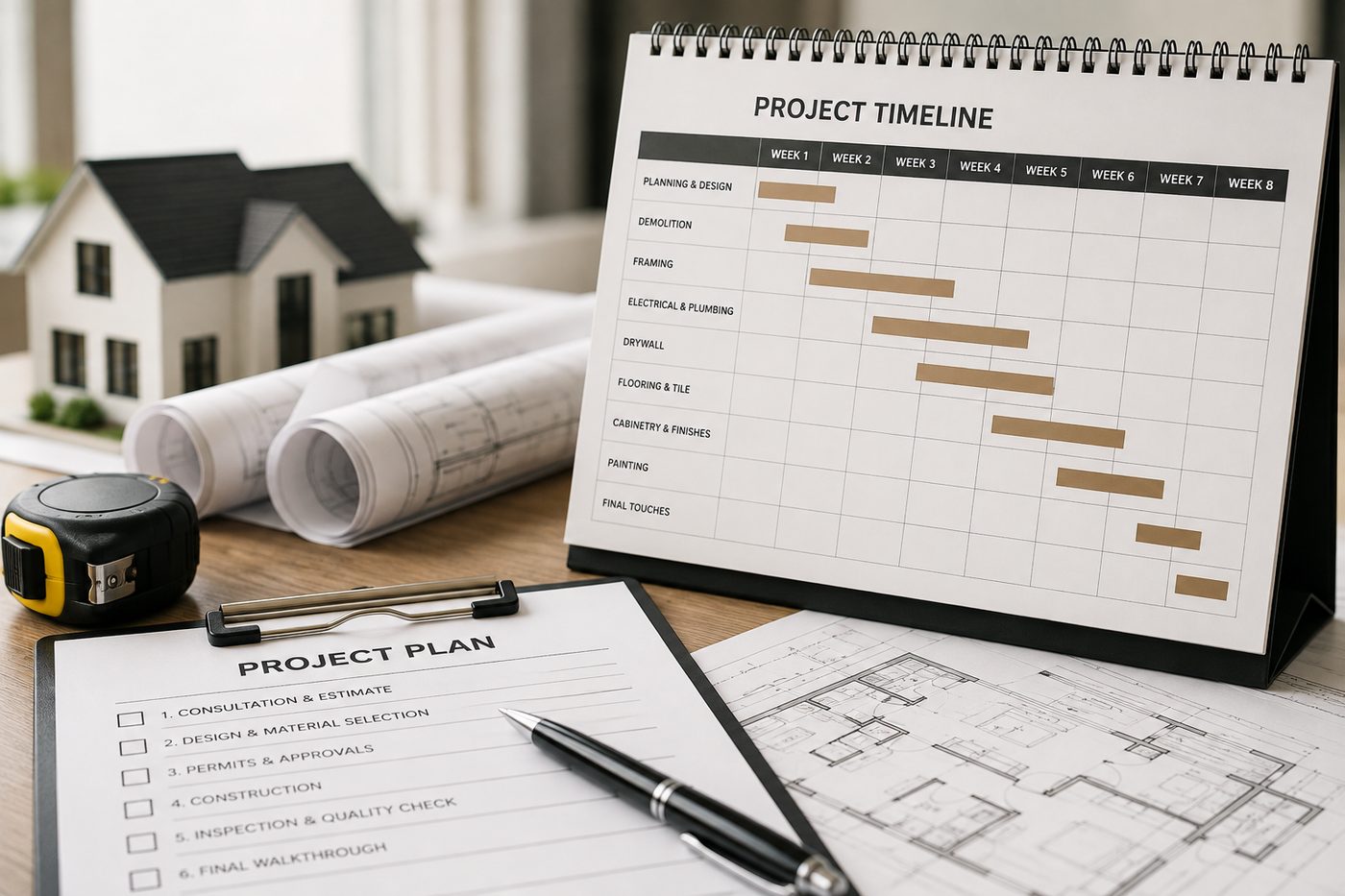
"How long will this take?" is right up there with "how much will it cost?" — and for good reason. A remodel disrupts your home, so knowing the timeline helps you plan your life around it. The honest answer ranges from a couple of weeks to a year or more, depending entirely on scope. Here's a realistic breakdown for Seattle projects, plus the things that speed them up or slow them down.
Typical timelines by project type
Single bathroom — about 2–4 weeks
A standard full bathroom usually takes two to four weeks on site once demolition begins. Waterproofing and tile need time to cure and set properly, and rushing those steps is exactly what causes problems later. A powder room can be quicker; a large master bath with layout changes takes longer.
Kitchen — about 6–10 weeks
Kitchens run longer largely because of cabinet lead times. Custom or semi-custom cabinets can take several weeks to arrive after ordering, and much of the finish work waits on them. Add countertop templating and fabrication, plus any electrical and plumbing changes, and a full kitchen typically lands in the six-to-ten-week range.
Whole-home remodel — several months
A whole-home project is really many remodels sequenced together, so it commonly runs three to six months or more. The upside of doing it all at once is a cohesive result and a single coordinated team, rather than living through repeated disruptions over several years.
Flooring — days to about a week
Flooring is one of the faster projects. A single room is often done in a day or two; a full main floor usually takes several days. Refinishing hardwood adds drying time between coats, which stretches the schedule a bit.
Painting — days to a couple of weeks
A single room can be painted in a day or two, a whole-home interior in about a week, and an exterior repaint depends on size and Seattle's weather windows.
A key distinction: the timeline on site is not the whole story. Design, product selection and permitting all happen before the crew shows up — and that pre-construction phase can add weeks. Building it into your plan prevents disappointment.
What happens before work begins
A smooth project is front-loaded with planning. For most remodels, expect these steps before demolition:
- Design and 3D renderings so you can see and approve the plan.
- Selections — tile, fixtures, cabinets, counters and finishes, all decided up front.
- Permitting, when the project requires it, which is governed by Seattle DCI and can take time.
- Ordering, especially long-lead items like cabinets, so they arrive when the schedule needs them.
Deciding everything before the crew starts is the single best thing you can do to keep a project on schedule.
What causes delays in Seattle
Even well-run projects hit variables. The common ones here:
- Permit and inspection timing. City review and inspection windows aren't fully in a contractor's control, so we build realistic buffers in.
- Hidden conditions in older homes. Water damage, dated wiring or failing plumbing discovered during demolition can add scope — we flag and price these with your approval.
- Material lead times. Custom cabinets, specialty tile and certain fixtures can take weeks to arrive.
- Change orders. Mid-project decisions are the most common self-inflicted delay. Locking in choices early avoids them.
- Weather, for exterior work — Seattle's rain can move outdoor timelines.
How a good contractor keeps you on schedule
Timelines hold when a project is managed, not just built. What to look for:
- A written schedule before work starts, with milestones you can track.
- Long-lead items ordered early so trades never wait on materials.
- One team coordinating every trade, so there are no gaps between the plumber, tiler and electrician.
- Daily site check-ins and honest communication when something shifts.
Our approach: we take on a limited number of projects at a time specifically so we can stay involved and keep each one moving. A schedule is only worth something if someone is actively protecting it.
How to shorten your timeline
Some of the biggest time savings are in your hands, long before demolition. The homeowners whose projects finish fastest tend to do the same things:
- Make selections early and stick with them. Every finish decided before we start is one that can't stall the crew mid-project. Indecision is the most common cause of delay we see.
- Order long-lead items first. Cabinets, specialty tile and certain fixtures drive kitchen and bath schedules — the sooner they're ordered, the sooner the finish work can begin.
- Bundle related work. If you're redoing floors and paint anyway, doing them alongside a larger remodel is faster than scheduling separate projects later.
- Keep decisions with one point of contact. Fast, clear answers keep trades moving; a project that waits on approvals loses days it never gets back.
None of this cuts corners — it simply removes the pauses that stretch a schedule without adding any actual work.
The bottom line
Plan on roughly two to four weeks for a bathroom, six to ten for a kitchen, days for flooring, and several months for a whole home — plus a planning and permitting runway before any of it. The best way to get a realistic schedule for your project is a walkthrough and a written plan, which is exactly where a free estimate begins.
Get a Free Estimate
Planning a project in the Greater Seattle Area? We'll give you a fixed-price estimate — no pressure.
Get a Free Estimate